Natural Nervous System Reset: Aromatic Tools For a Sensory Weary World
 By Karen Williams · December 26, 2025 · 9 min read
Natural Nervous System Reset: Aromatic Tools for a Sensory-Weary World
Simple, scent-based rituals to help you regulate in a world that’s constantly asking too much.
Some days, life just feels full in every direction. There’s too much input, too many voices, too many things pulling your attention. You may not even notice it at first. But your body knows. Your shoulders are up near your ears, your breathing shallow, your focus scattered. You feel like you need quiet, but don’t know how to find it. It’s time to step out of the fast-moving loop so many of us find ourselves in, and return to what supports us, both inside and out.
This is sensory overload. It often goes unnoticed because we’ve conditioned ourselves not to notice. We’ve learned to override the signals, small and large, that tell us something is off... it carries a kind of negativity that our bodies aren't designed to process or hold, physically, emotionally, energetically.
The Hidden Load Our Nervous System Carries
The demands placed on our senses today are vastly different from those our bodies evolved with. We live in a world our bodies weren’t built for. What was once the occasional call of a bird or the rustle of wind through trees has now become a steady stream of digital noise.
Our nervous systems are constantly filtering through bright screens, overlapping conversations, synthetic fragrances, buzzing notifications, and the relentless pressure to multitask. It’s easy to overlook how much this modern landscape asks of us, but the effects are real. Even when we’re not fully aware of it, our senses are working overtime to keep up, and the toll it takes often shows up as fatigue, irritability, or a sense of being ungrounded.
Fortunately, science is catching up to what many of us intuitively know: the natural world offers real relief. A 2021 review found that increased exposure to nature is strongly associated with lower cortisol levels, improved sleep, elevated mood, and reduced symptoms of chronic stress and anxiety (Jimenez et al., 2021). Another study found that children performed significantly better on cognitive tasks when listening to nature sounds like ocean waves and cricket chirps, compared to the mental strain triggered by traffic and café noise (Lee et al., 2015).
These findings remind us of something vital: returning to nature, even in simple ways, can help reset the nervous system. It doesn't always require a grand escape, just a mindful pause, a few deep breaths with a trusted blend, or the grounding rhythm of your footsteps on the earth.
Reconnection Is the Reset
The parasympathetic nervous system is often referred to as the "rest and digest" system. It’s the branch of the autonomic nervous system responsible for bringing the body back into a state of calm after periods of stress or activity. When this system is active, heart rate slows, digestion resumes, and the body begins to repair and regulate itself.
This system balances the effects of the sympathetic nervous system that is our "fight or flight" response, and helps the body return to homeostasis. It plays a crucial role in regulating inflammation, lowering cortisol, and restoring immune function. Activating the parasympathetic system is about supporting the body’s ability to respond wisely and recover fully.
Aromatherapy is one powerful way to help cue this shift. Studies show that essential oils, through olfactory pathways, stimulate the limbic system, governing emotion, memory, and autonomic functions like heart rate and breathing (Yang et al., 2021; Lizarraga-Valderrama et al., 2023).
The nervous system wants to come back to balance. It knows how to do this. When we give ourselves space from the modern world, and just for a few moments, take ourselves back to where it all began, that's where healing can truly happen. It might look like stepping outside. Closing your eyes. Taking in the scent of earth or wood or a single drop of essential oil. These small moments are gigantic. They give the nervous system a chance to recalibrate. They remind us that the way back is often simpler than we think.
The Living Support of the Natural World
Each morning as the sun rises from the east, we are given the chance to begin anew, see anew, and do things that actually support our being.
The regulating effects of nature can be felt wherever you are: forest, ocean, or right outside your door. Research continues to affirm what many of us feel instinctively: our bodies respond to natural light, organic patterns, scent, and green space in ways that directly impact our physical and mental health (White et al., 2019; Alcock et al., 2014).
Saying it simply:
- Scent travels fast, directly to the emotional center of your brain.
- One intentional inhale can begin to soften your nervous system’s response.
- Aromatherapy supports regulation, presence, and calm.
- Different parts of the plant offer different kinds of support.
Essential Oils by Plant Part + Recipes
🌱 From the Root: Vetiver (Chrysopogon zizanioides)
Vetiver is distilled from the roots of tall grasses, and it smells like earth itself, cool, steady, and strong. It’s one of the most grounding oils available and is considered one of the top essential oils for reducing anxiety. Just one drop can help settle a spinning mind and draw your energy down.
Use it in the evening, diluted into a carrier like unscented lotion. Apply to the soles of your feet, and give yourself or someone else a slow foot rub, especially in the arch area.
🍃 From the Leaf: Petitgrain (Citrus aurantium var. amara)
Petitgrain is distilled from the leaves and twigs of the same tree that gives us Neroli. It’s bright and slightly woody. Rich in linalyl acetate and linalool, this oil is calming to the nervous system and supports emotional balance.
Add a drop to your palms with your favorite carrier, rub gently, and inhale before transitioning between tasks.
🌸 From the Flower: Roman Chamomile (Chamaemelum nobile)
Soft and sweet, Roman Chamomile is a balm for frayed emotions. With over 70% esters, including those known for antispasmodic and sedative properties, this oil supports emotional digestion.
A blend near the heart or an inhaler brings comfort during overwhelm.
🌰 From the Seed: Cardamom (Elettaria cardamomum)
Fresh and revitalizing. Rich in 1,8-cineole, d-limonene, and α-terpinyl acetate, Cardamom supports breath, digestion, and a sense of uplift.
Inhale gently or blend into a body oil for massage.
🪵 From the Wood: Cedarwood (Juniperus virginiana)
Deep and steady. With α-cedrene and cedrol, Cedarwood brings a feeling of structure and calm.
Diffuse near a window in the afternoon, or pair with journaling.
🪔 From the Resin: Frankincense (Boswellia carterii)
With α-pinene, Frankincense calms anxiety and encourages deeper breathing.
Use in a quiet space or apply a blend near the heart and inhale slowly.
🍊 From the Fruit: Sweet Orange (Citrus sinensis)
Uplifting and cheerful. Filled with d-limonene, a natural anxiolytic, this oil brings out emotions into balance and energizes.
Diffuse or blend with lotion to lift mood.
🌲 From the Needle: Engelmann Spruce (Picea engelmannii)
Crisp and clearing. Its aroma blends limonene, α-pinene, and camphor—bringing the breath of the forest indoors.
Ideal for diffusers, inhalers or chest rubs.
Below are 3 recipes that I enjoy! Each oil below is a gift from the plant world, distilled into a form that can support our nervous system in very real ways. Whether you choose one or a few, trust that even the simplest ritual can create space, soften tension, and guide your body back toward balance.

Inhaler Blend: Clear the Static, Invite Calm
- 5 drops Engelmann Spruce Oil (Picea engelmannii)
- 5 drops Cedarwood Oil (Juniperus virginiana)
- 5 drops Petitgrain Oil (Citrus aurantium var. amara)

Diffuser Blend: Breathe + Digest
Also helpful for digestion while easing overstimulation.
- 3 drops Sweet Orange Oil (Citrus sinensis)
- 3 drops Cardamom Oil (Elettaria cardamomum)
3 drops Frankincense Oil (Boswellia carterii)
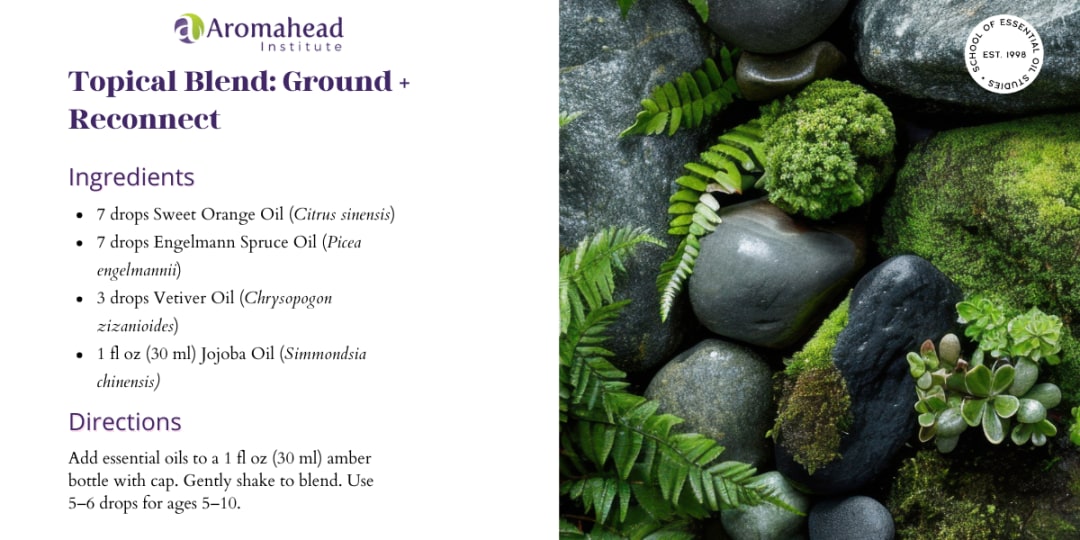
Topical Blend: Ground + Reconnect
Use 5–6 drops for ages 5–10. Dilute in 1 fl oz (30 ml) carrier oil such as jojoba or unscented lotion.
- 7 drops Sweet Orange Oil (Citrus sinensis)
- 7 drops Engelmann Spruce Oil (Picea engelmannii)
3 drops Vetiver Oil (Chrysopogon zizanioides)
Finding a Small Space Just For You
A chair by the window, a quiet corner on the floor, or even a spot at your kitchen counter where you can pause for a few breaths. What matters is that the space feels comfortable and one that belongs to you.
You might choose to light a natural candle (free from synthetic fragrance) to bring in warmth. Maybe this space becomes your simple altar or a place to return to daily or when you need a reset. Add objects that connect you to nature: a smooth stone, a feather you found on a walk, your favorite crystal, a small bowl of dried herbs or petals, or even a photograph that reminds you of the wild.
Keep one essential oil or a blend nearby. This is a signal to your body, reminding you that each time you reach for it, this is your moment for revitalizing!
These rituals can be simple and offered with gratitude. What matters is that they support your body and your sense of inner calm. And over time, your nervous system will begin to associate this place with softness, safety, and choice.
Sound, and the Kind That Supports
Step outside and notice the sounds are different. Instead of mechanical hums or the shrill ping of alerts, you hear wind moving through branches. Leaves rustling, a bird calling, the chatter of a chipmunk. Even in cities, there is often something natural trying to reach us: the breeze against a building, the scent of something green or floral nearby, the call of something in nature. What do you hear that you haven't taken the time to hear before?
Your nervous system immediately notices the difference. If you are in the desert, notice the silence or the un-silence.
These sounds are different kinds of information that are organic and supportive. In their presence, we find ourselves breathing more fully, with shoulders that feel strong and supportive. We re-enter a relationship with the natural world, and in doing so, we return to something in ourselves that is the gateway to all healing.
My Takeaway
This work is about returning to life in a fuller, more connected way. The trees, the flowers, the roots, the sunlight, they greet us with beauty and fragrance and stillness.
We are designed for relationship, with ourselves, with the natural world, and with ways that help us feel grounded and whole. This is a practice of supporting you. And when you support you, you support those around you.
So take a moment today. Find a small space. Choose one aroma. It might even be smelling pine needles on a tree, or the grass and maybe even the sea! We are all interconnected. What affects one person sends out waves that affect us all. Join me as we send positivity into the world through thought, breath, and our connection to the natural world.
This is how we begin again, gently, intentionally, and with deep respect for the body that carries us through it all.
References & research
Yao, W., Zhang, X., & Gong, Q. (2021). The effect of exposure to the natural environment on stress reduction: A meta‑analysis. Urban Forestry & Urban Greening, 57, 126932.
Root in NatureKaplan, S., & Kaplan, R. (1995). The Experience of Nature: A Psychological Perspective. (Attention Restoration Theory).
WikipediaGascon, M., et al. (2015). Nature and mental health: An ecosystem service perspective. International research linking green space and wellbeing.
ScienceDirectYang, W., et al. (2021). The Effects of Essential Oils on the Nervous System: A Scoping Review. Molecules.
MDPIBae, I., Song, J.‑A., Lee, M., et al. (2018).
Effects of Aromatherapy Essential Oil Inhalation on Stress Response. Int J Clin Exp Med.
e-century.usLizarraga‑Valderrama, L. R., et al. (2023). Essential oils and their potential neuropharmacological effects. Phytotherapy Research.
Springer LinkAromachology overview (Study of odors and human behavior).
WikipediaOverview of parasympathetic nervous system function and sensory influence.
In Fiore

Lead instructor and face of Aromahead. Karen has taught tens of thousands of students to blend with confidence, from first drop to clinical practice.
This is what Natural Living begins, and certification completes.
Start with the chemistry, safe dilution, and blending in Natural Living · Natural Living. Free to begin.
A new oil, a recipe, and a lesson — every week.
Join the free weekly email and keep learning between visits. No spam, just good aromatherapy.
Free forever · unsubscribe anytime · written by the Aromahead instructor team.