Essential Oil Chemistry: 1,8-Cineole Benefits, Safety, and Oils High in Eucalyptol
 By Karen Williams · February 27, 2026 · 7 min read
When you understand essential oil chemistry, aromatherapy becomes precise, intentional, and deeply empowering.
Instead of selecting oils based only on aroma or tradition, you begin to understand why an oil works. That shift builds confidence, credibility, and professional clarity.
One of the most researched and therapeutically significant components in essential oils is 1,8-cineole, also known as eucalyptol. This naturally occurring oxide contributes to the fresh, penetrating aroma of many respiratory oils and offers well documented therapeutic properties.
In this article, we will explore what 1,8-cineole is, why it matters in essential oil chemistry, which oils contain high levels, how rectification influences cineole percentages, and how to use these oils safely and effectively.
What Is 1,8-Cineole?
1,8-cineole is an oxide found in many aromatic plants. It is especially abundant in essential oils traditionally used to support the respiratory system.
This component contributes to:
- A cooling, clearing aromatic profile
- Mucolytic activity that helps loosen and mobilize mucus
- Anti-inflammatory effects
- Antimicrobial properties
- Relaxation of airway smooth muscle
Because of these characteristics, oils rich in 1,8-cineole are often selected during seasonal respiratory challenges, sinus congestion, and spasmodic coughing.
Understanding how much cineole is present in an oil requires examining its chemical composition through GC/MS testing.

Why Chemistry Matters in Aromatherapy
Essential oils are composed of hundreds of natural chemical constituents. The balance of these components determines:
- Therapeutic effects
- Safety considerations
- Appropriate dilution guidelines
- Skin compatibility
- Blending strategy
This is why GC/MS testing is essential for responsible aromatherapy practice.
What Is GC/MS Testing?
Gas Chromatography separates the volatile components of an essential oil and presents them as a linear graph.
Mass Spectrometry identifies each individual compound and calculates its percentage within the oil.
A GC/MS report allows you to:
- Determine the exact percentage of 1,8-cineole
- Confirm the botanical authenticity of the oil
- Detect potential adulteration
- Better understand therapeutic behavior and safety considerations
Understanding GC/MS reports provides the chemical clarity needed to practice aromatherapy responsibly. From that foundation, practitioners can confidently explore plant energetics, intuition, and emotional applications.

Essential Oils High in 1,8-Cineole
The following essential oils are known for significant cineole content:
- Eucalyptus (Eucalyptus globulus)
- Eucalyptus (Eucalyptus radiata)
- Eucalyptus (Eucalyptus smithii)
- Helichrysum (Helichrysum gymnocephalum)
- Niaouli (Melaleuca quinquenervia ct 1,8-cineole)
- Saro (Cinnamosma fragrans)
- Laurel Leaf (Laurus nobilis)
- Ravintsara (Cinnamomum camphora ct 1,8-cineole)
Each oil contains a full spectrum of constituents that influence its overall effect, but 1,8-cineole often plays a central therapeutic role.

Cineole Percentages and Rectification in Eucalyptus Oils
Not all eucalyptus oils are chemically equivalent, and understanding rectification is important for advanced practice.
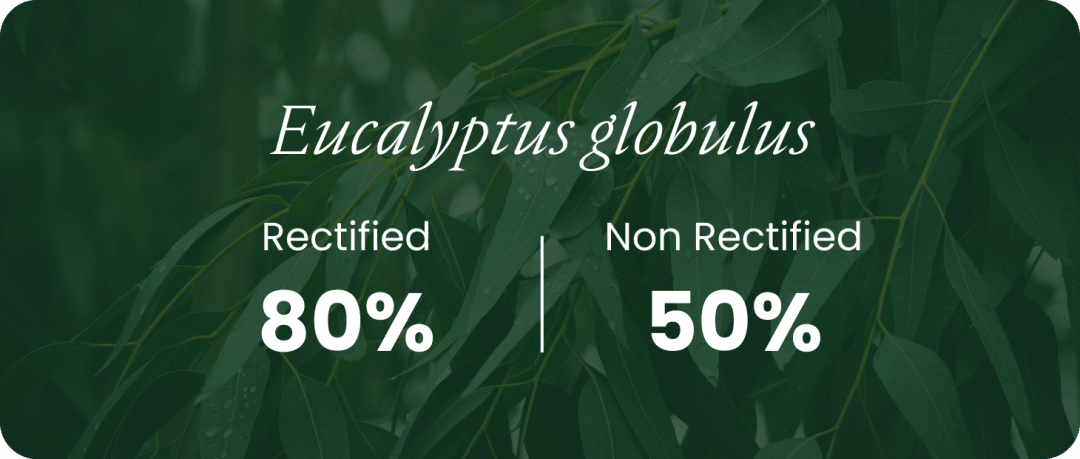
A rectified Eucalyptus globulus can contain over 80 percent 1,8-cineole. Rectification is a redistillation process that concentrates specific constituents, often increasing the cineole percentage while reducing certain minor components.
An authentic, non rectified distillation of Eucalyptus globulus typically contains between 50 percent and the lower 70 percent range of 1,8-cineole, depending on growing conditions, harvest timing, and distillation methods. This range reflects preservation of the oil’s naturally occurring minor constituents and overall chemical balance.
Eucalyptus radiata generally is not rectified and typically contains 65 to 75 percent 1,8-cineole naturally. Its cineole level tends to fall within a narrower and more predictable range.
Eucalyptus smithii is also commonly available in rectified form, with cineole levels adjusted upward through redistillation.
Regulatory standards can also influence rectification practices. In some countries, including the United Kingdom, pharmacopoeial standards specify minimum 1,8-cineole percentages for certain eucalyptus oils. To meet these standards, producers may rectify Eucalyptus globulus to increase its cineole content to the required level.
Understanding these regulatory frameworks helps explain why cineole percentages may vary across suppliers and regions. Reviewing a GC MS report remains the most reliable way to evaluate an oil’s chemical composition.
Therapeutic Properties of 1,8-Cineole
Extensive research has identified multiple biological activities associated with 1,8-cineole.
Respiratory Support
- Mucolytic action
- Anti-inflammatory activity within respiratory tissues
- Antispasmodic effects for coughing
- Antiviral properties
- Airborne antimicrobial action
Clinical studies have explored its role in bronchitis, sinusitis, and inflammatory respiratory conditions.
Pain and Inflammation
- Analgesic activity
- Anti-inflammatory properties
- Potential reduction of tissue swelling
Circulatory and Neurological Effects
- Hypotensive effects in studied models
- Increased cerebral blood flow observed in imaging studies
- Antioxidant activity
While respiratory applications remain primary in aromatherapy practice, these additional systemic effects contribute to its therapeutic relevance.

Practical Applications
Oils high in 1,8-cineole are most effective when used intentionally and with proper dilution. Below are practical ways to incorporate cineole rich oils into everyday use. You will notice we use the same essential oils in each recipe, simply adapting them for different modalities.
Diffusion
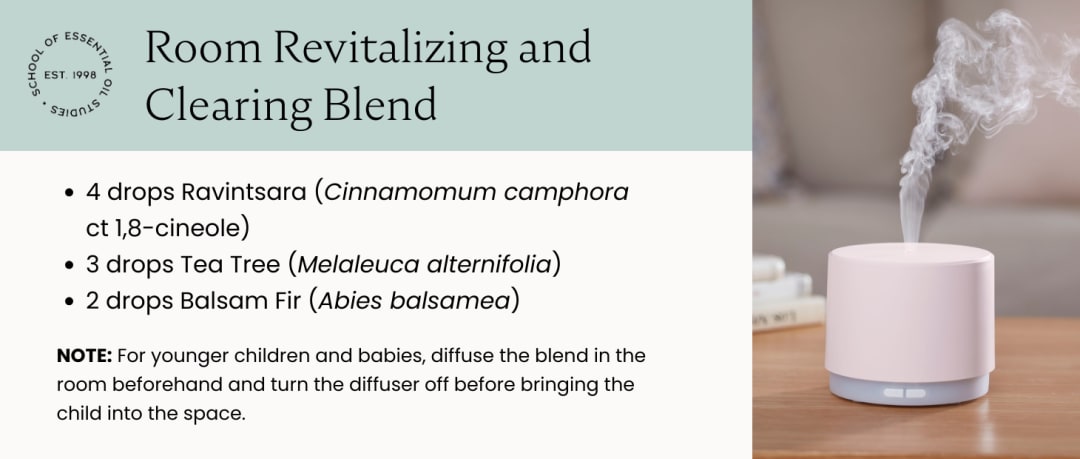
Room Revitalizing and Clearing Blend
This blend supports clear breathing and freshens the environment during seasonal challenges.
Diffuser Blend
- 4 drops Ravintsara (Cinnamomum camphora ct 1,8-cineole)
- 3 drops Tea Tree (Melaleuca alternifolia)
- 2 drops Balsam Fir (Abies balsamea)
Add 6 to 10 total drops to your diffuser, depending on room size. Diffuse intermittently rather than continuously.
This combination offers respiratory support while maintaining a balanced and refreshing aroma.
Steam Inhalation
Respiratory Support Steam
For convenience, create a stock blend of the diffuser formula.
Stock Blend (5 ml bottle, approximately 100 drops total):
- 45 drops Ravintsara (Cinnamomum camphora ct 1,8-cineole)
- 35 drops Tea Tree (Melaleuca alternifolia)
- 20 drops Balsam Fir (Abies balsamea)
To use: Add 1 drop of the stock blend to a bowl of steaming water. Lean over the bowl, cover your head with a towel, and inhale gently for several minutes. Keep eyes closed during inhalation.
This method delivers targeted aromatic support to the upper respiratory system. Preparing a stock blend makes your work easier and more consistent. The same blend can be used in the diffuser, for steam inhalation, in personal inhalers, or diluted for topical application. One well designed formula can support you across multiple modalities.

Chest Applications
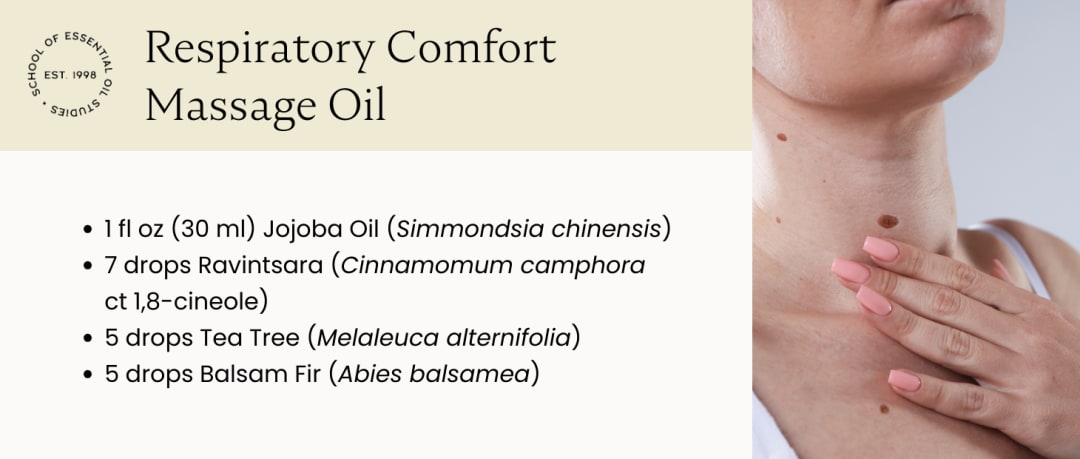
Respiratory Comfort Massage Oil
For short term topical support, dilute appropriately.
- 1 fl oz (30 ml) Jojoba Oil (Simmondsia chinensis)
- 7 drops Ravintsara (Cinnamomum camphora ct 1,8-cineole)
- 5 drops Tea Tree (Melaleuca alternifolia)
- 5 drops Balsam Fir (Abies balsamea)
Massage onto the chest and upper back as needed.
Chest Salve
Respiratory Support Chest Salve 2 ounces (56 g)
This creates a semi firm salve appropriate for short term seasonal use.
Ingredients:
- 1.75 fluid ounces (52 ml) Jojoba Oil (Simmondsia chinensis)
- 0.25 ounces (7 g) Beeswax (Cera flava)
- 8 drops Ravintsara (Cinnamomum camphora ct 1,8-cineole)
- 6 drops Tea Tree (Melaleuca alternifolia)
- 4 drops Balsam Fir (Abies balsamea)
Gently melt the jojoba oil and beeswax in a double boiler. Remove from heat, allow to cool slightly, then stir in essential oils. Pour into a 2 ounce jar and allow to solidify.
Apply to the chest and upper back as needed.

Blending for Broader Support
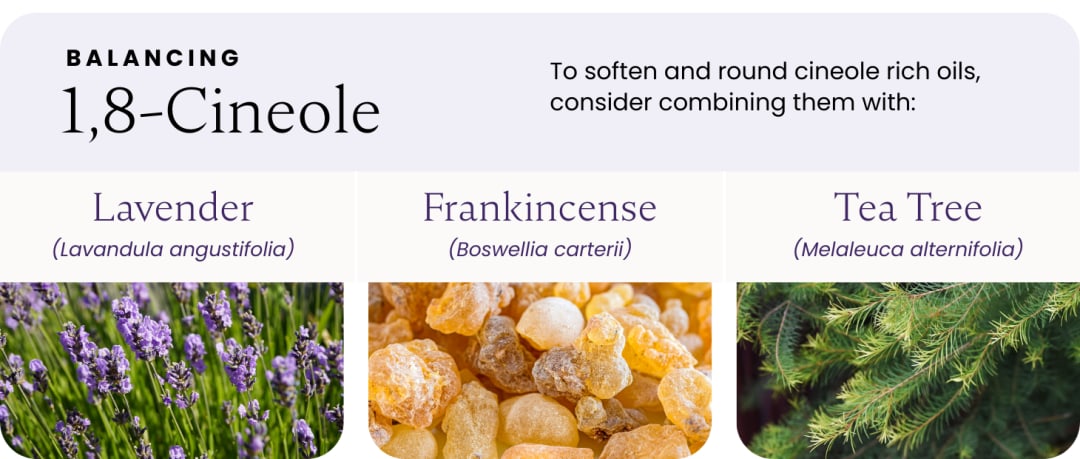
To soften and round cineole rich oils, consider combining them with:
- Lavender (Lavandula angustifolia)
- Frankincense (Boswellia carterii)
- Tea Tree (Melaleuca alternifolia)
These oils can help balance the sharpness of high cineole content while expanding the therapeutic profile of a blend.
Modifications for Children
When preparing these blends for children ages 5 to 10, substitute the Ravintsara (Cinnamomum camphora ct 1,8-cineole) with Cedarwood (Juniperus virginiana). This creates a gentler aromatic profile while still offering supportive benefits.
For topical use with children in this age range, decrease the total concentration of essential oils to 6 drops per 1 fluid ounce (30 ml) of carrier oil. For example, a 2 ounce (60 ml) chest rub would contain a total of 12 drops of essential oils.
The diffuser blend may be used for all ages. For younger children and babies, diffuse the blend in the room beforehand and turn the diffuser off before bringing the child into the space. This allows the aroma to disperse softly without direct exposure.
Safety Considerations
Cineole rich oils are potent and should be used responsibly. The essential oils in this article that are rich in 1,8-cineole include Eucalyptus globulus, Eucalyptus radiata, Eucalyptus smithii, Helichrysum gymnocephalum, Niaouli, Saro, Laurel Leaf, and Ravintsara.
These oils are fresh, clearing, and powerful. Because they are so active in the respiratory system, they are best used with care.
- Cineole-rich oils are too strong to use on or near the face of babies and children under ten years old.
- Avoid using them in facial applications, nasal inhalers, or steam inhalations for children under ten.
- For children ages five to ten, use cineole-rich oils with caution, in very low amounts, and only when appropriate. At Aromahead Institute, we do not recommend topical essential oil use for children under five years old.
- Care must also be taken with asthma, COPD, reactive airways, or any history of respiratory sensitivity. Begin with gentle exposure, avoid direct inhalation, and discontinue use immediately if coughing, wheezing, chest tightness, shortness of breath, or a feeling of constriction occurs.
- Always dilute before topical application.
- These oils are best suited for short term respiratory support rather than prolonged daily diffusion.
Understanding essential oil chemistry allows for confident and appropriate use.
Frequently Asked Questions About 1,8-Cineole
What does 1,8-cineole do in essential oils?
1,8-cineole contributes mucolytic, anti-inflammatory, antimicrobial, and antispasmodic properties. It is most often used to support respiratory comfort and clear breathing.
Which essential oil contains the most 1,8-cineole?
Rectified Eucalyptus globulus can exceed 80 percent 1,8-cineole. Authentic, non rectified Eucalyptus globulus typically ranges between 50 percent and the lower 70 percent range. Eucalyptus radiata generally contains 65 to 75 percent naturally.
Is 1,8-cineole safe for children?
Cineole rich oils should be used cautiously with children. Cineole-rich oils are too strong to use on or near the face of babies and children under ten years old. Avoid using them in facial applications, nasal inhalers, or steam inhalations for children under ten.
Is 1,8-cineole the same as eucalyptol?
Yes. Eucalyptol is the common name for 1,8-cineole.
Can cineole rich oils support sinus discomfort?
Research suggests that 1,8-cineole has mucolytic and anti-inflammatory properties that may help support sinus comfort when used appropriately.
References & research
Sato K, Krist S, Buchbauer G (2007) Antimicrobial effect of vapours of geraniol, (R)-(-)-linalool, terpineol, gamma-terpinene and 1,8-cineole on airborne microbes using an airwasher. Flavour & Fragrance Journal 22:435-43
Santos FA, Rao VS (2000) Anti-inflammatory and antinociceptive effects of 1,8-cineole a terpenoid oxide present in many plant essential oils. Phytotherapy Research 14:240-244
Liapi C, Anifandis G, Chinou I et al (2007) Antinociceptive properties of 1,8-cineole and beta-pinene, from the essential oil of Eucalyptus camaldulensis leaves, in rodents. Planta Medica 73:1247-1254
Pattnaik S, Subramanyam VR, Bapaji M et al (1997) Antibacterial and antifungal activity of aromatic constituents of essential oils. Microbios 89:39-46
Carson CF, Mee BJ, Riley TV (2002) Mechanism of action of Melaleuca alternifolia (tea tree) oil on Staphylococcus aureus determined by time-kill, lysis, leakage, and salt tolerance assays and electron microscopy. Antimicrobial Agents and Chemotherapy 46:1914-1920
Juergens UR, Dethlefsen U, Steinkamp G et al (2003) Anti-inflammatory activity of 1,8 cineole (eucalpytol) in bronchial asthma: a double blind, placebo controlled trial. Respiratory Medicine 97:250-256
Juergens UR, Engelen T, Racke K (2004) Inhibitory activity of 1,8-cineol (eucalyptol) on cytokine production in cultured human lymphocytes and monocytes. Pulmonary Pharmacology & Therapeutics 17:281-287
Santos FA, Silva RM, Campos AR et al (2004) 1,8-Cineole (eucalyptol), a monoterpene oxide attenuates the colonic damage in rats on acute TNBS-colitis. Food & Chemical Toxicology 42:579-584
Nascimento NR, Refosco RM, Vasconcelos EC (2009) 1,8-Cineole induces relaxation in rat and guinea-pig airway smooth muscle. Journal of Pharmacy & Pharmacology 61:361-366
Coelho-de-Souza LN, Leal-Cardoso JH, De Abreu Matos FJ et al (2005) Relaxant effects of the essential oil of Eucalyptus tereticornis and its main constituent 1,8-cineole on guinea-pig tracheal smooth muscle. Planta Medica 71:1173-1175
Bastos VP, Brito TS, Lima FJ et al (2009) Inhibitory effect of 1,8-cineole on guinea-pig airway challenged with ovalbumin involves a preferential action on electromechanical coupling. Clinical & Experimental Pharmacology & Physiology 36:1120-1126
Kako H, Fukumoto S, Kobayashi Y et al (2008) Effects of direct exposure of green odour components on dopamine release from rat brain striatal slices and PC12 cells. Brain Research Bulletin 75:706-712
Lahlou S, Figueiredo AF, Magalhaes PJ et al (2002) Cardiovascular effects of 1,8 cineole, a terpenoid oxide present in many plant essential oils, in normotensive rats. Canadian Journal of Physiology & Pharmacology 80:1125-1131
Pinto NV, Assreuy AM, Coelho-de-Souza AN et al (2009) Endothelium-dependent vasorelaxant effects of the essential oil from aerial parts ofAlpinia zerumbet and its main constituent 1,8-cineole in rats. Phytomedicine 16:1151-1155
Kehrl W, Sonnemann U, Dethlefsen U (2004) Therapy for acute nonpurulent rhinosinusitis with cineole: results of a double-blind, randomized, placebo-controlled trial. 114:738-742
Tesche S, Metternich F, Sonnemann U et al (2008) The value of herbal medicines in the treatment of acute non-purulent rhinosinusitis. Results of a double-blind, randomised, controlled trial. European Archives of Oto-Rhino-Laryngology 265:1355-1359
Worth H, Schacher C, Dethlefsen U (2009) Concomitant therapy with Cineole (Eucalyptole) reduces exacerbations in COPD: a placebo-controlled double-blind trial. Respiratory Research 10:6
Astani A, Reichling J, Schnitzler P. (2010) Comparative study on the antiviral activity of selected monoterpenes derived from essential oils. Phytotherapy Research 24(5):673-679
Matthys H, de Mey C, Carls C et al (2000) Efficacy and tolerability of myrtol standardized in acute bronchitis. A multi-centre, randomised, double-blind, placebo-controlled parallel group clinical trial vs. cefuroxime and ambroxol. Arzneimittelforschung 50:700-711
Meister R, Wittig T, Beuscher N, et al (1999) Efficacy and tolerability of myrtol standardized in long-term treatment of chronic bronchitis. A double-blind, placebo-controlled study. Study Group Investigators. Arzneimittelforschung 49:351-358
Saito Y, Shiga A, Yoshida Y et al (2004) Effects of a novel gaseous antioxidative system containing a rosemary extract on the oxidation induced by nitrogen dioxide and ultraviolet radiation. Bioscience Biotechnology & Biochemistry 68:781-786
Nasel C, Nasel B, Samec P, Schindler E et al (1994) Functional imaging of effects of fragrances on the human brain after prolonged inhalation. Chemical Senses 19(4):359-364

Lead instructor and face of Aromahead. Karen has taught tens of thousands of students to blend with confidence, from first drop to clinical practice.

This is what Natural Living begins, and certification completes.
Start with the chemistry, safe dilution, and blending in Natural Living · Natural Living. Free to begin.
A new oil, a recipe, and a lesson — every week.
Join the free weekly email and keep learning between visits. No spam, just good aromatherapy.
Free forever · unsubscribe anytime · written by the Aromahead instructor team.