Cedarwood Essential Oil Benefits & Uses: Know Your Three Cedars
 By Karen Williams · August 4, 2026 · 8 min read
Cedarwood is the oil I reach for when someone needs to settle. It comes from the wood of the tree, it smells like a forest floor after rain, and it is one of the few oils that almost everyone likes on first sniff. It is also one of the safest oils on the shelf, which means you can use it freely in inhalers, baths, creams, and body oils.
There is one thing worth knowing before you buy a bottle. Three different trees are sold as cedarwood, and they are not even in the same genus. The oils behave similarly, but each has a strength of its own. Here is how to tell them apart, what the research says, and how I actually use them.
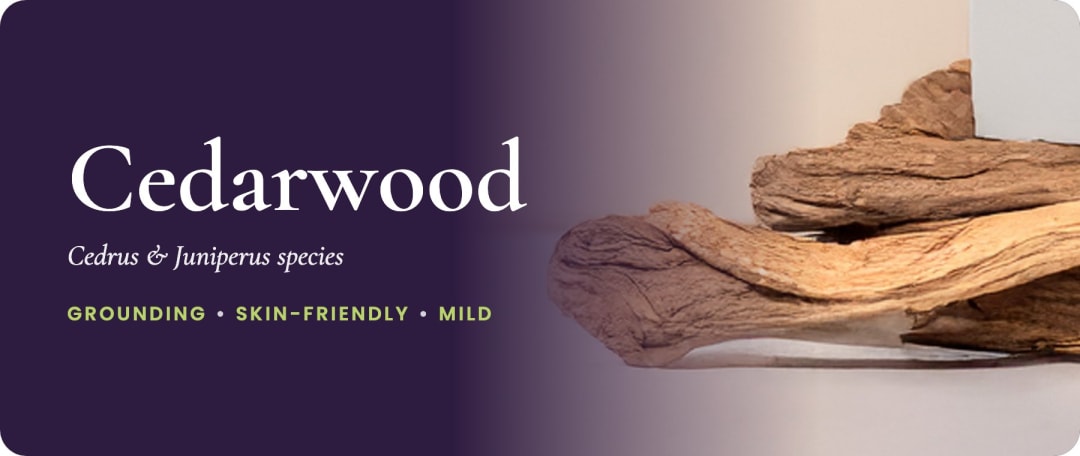
Three trees, one common name
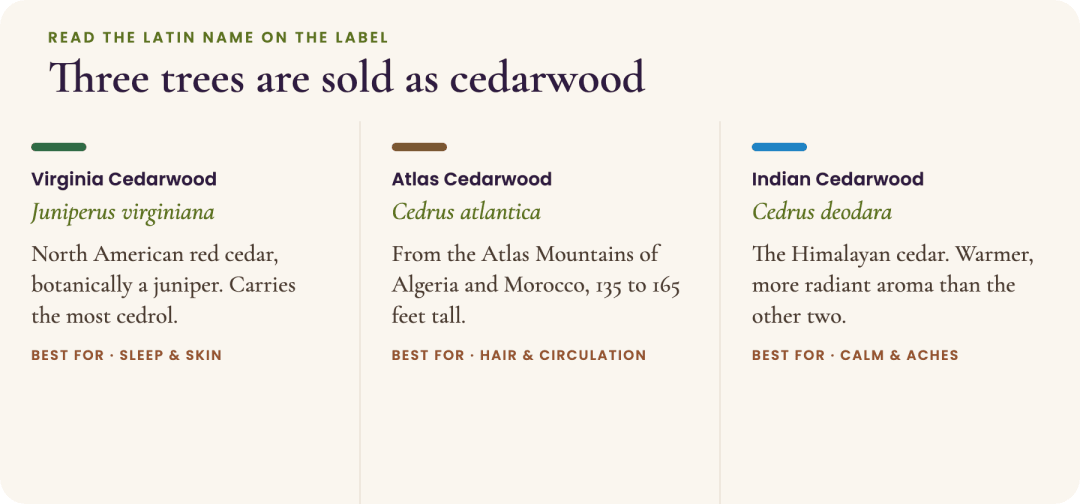
Look at the Latin name on the label. That is the only reliable way to know what is in the bottle.
Cedarwood (Juniperus virginiana) is distilled from the North American red cedar, which is botanically a juniper rather than a true cedar. It is high in sesquiterpenes and sesquiterpenols, and it carries the most cedrol of the three. I use it for skin repair and tone, for urinary support, and for anything to do with sleep.
Cedarwood (Cedrus atlantica) comes from the tree native to the Atlas Mountains of Algeria and Morocco, where it grows 135 to 165 feet tall. It is high in sesquiterpenes. This is the one I choose for hair and scalp care, for circulation, and for strengthening the respiratory system.
Cedarwood (Cedrus deodara), the Indian or Himalayan cedar, has a warmer, more radiant aroma than the other two. It is antifungal, decongestant, and analgesic, it calms the nervous system, and it even settles digestion. Emotionally it is the steadying one: it reduces anxiety, strengthens confidence, and helps you feel present.
All three are base notes, which is why cedarwood anchors a blend and keeps it from evaporating into thin air. Atlas and Virginia cedarwood keep for about eight years. Indian cedarwood keeps about six.
Why the species matters more than it sounds
This is not a technicality. On a Natural Allergy Support live this spring, one viewer said something I hear all the time:
I have noticed that alot of people in my classes do not love cedarwood
@lisachan7434 · Natural Allergy Support · Week 2
The replies were the interesting part. Replying to her, a viewer who is allergic to trees explained that cedarwood is her nemesis, that Atlas gives her major allergy attacks, and that the Himalayan is the one she can use without a reaction. Right behind her, someone else reported the exact opposite:
Cedrus deodora is my nemesis. I cant stands its aroma. Himalayan Cedarwood (Cedrus deodara)
@ausaromatica · Natural Allergy Support · Week 2
Which prompted the question that ought to be printed on every label:
Why are those two cedar woods different?
@lonnapossehl8666 · Natural Allergy Support · Week 2
Because they are different trees. Two people, the same common name on the bottle, opposite reactions. If cedarwood has ever disappointed you, there is a decent chance you simply met the wrong one.
Cedrol, and why cedarwood works even when you cannot smell it
Cedrol is a component found in cedarwood oil, and it does something unusual. In 2003, researchers in two separate studies found that cedrol relaxes the nervous system when it is only inhaled, with nothing applied to the skin. Later studies showed the same calming effect even when the research subjects could not fully smell the oil.
That finding changed how I blend. If I add cedarwood to a blend with a loud floral like rose, or a bright citrus, the cedarwood disappears under them. It used to feel like a waste of good oil. Now I know it is still working on the nervous system, quietly, underneath everything else.
What the research shows
Cedarwood turns up in a small but genuinely interesting set of clinical trials.
Hair growth. The best-known one is a 1998 randomized, double-blind trial published in the Archives of Dermatology. Eighty-six people with alopecia areata massaged their scalps daily for seven months. Half used a blend of thyme, rosemary, lavender, and cedarwood essential oils in a carrier of jojoba and grapeseed. The other half used the carrier oils alone. Nineteen of forty-three people in the essential oil group improved, compared with six of forty-one in the carrier-only group. Two dermatologists assessed the photographs independently, and the difference held up.
Behavioral symptoms in dementia. A 2020 trial in Neuropsychopharmacology Reports exposed thirty-six people with Alzheimer type dementia to cedar aroma over eight weeks. Behavioral and psychological symptoms improved compared with the control group at both four and eight weeks, and so did the caregiver burden scores. Cognitive test scores did not change. It is a small study of a specific preparation, so I hold it loosely, but the direction is worth knowing if you work with older adults.
Notice what both trials have in common: repeated, daily use over weeks. That is how cedarwood works. It is not a dramatic oil. It is a patient one.
How I use cedarwood
For sleep. This is where cedarwood earns its place. Put it in a bedtime diffuser blend, a bath salt, or a room spray for a child's room with a little sweet orange. The cedrol does the work whether or not the room smells strongly of it.
To protect skin in a strong blend. This is the practitioner trick I teach most often. Cedarwood is mild and skin-nourishing. When you build a muscle blend around ginger and peppermint, oils that can irritate, adding cedarwood contributes to the pain relief and buffers the skin against the sharper oils. You get a stronger blend that is kinder to wear.
For bugs and ticks. Cedrol is also largely responsible for cedarwood's reputation as an insect repellent. Juniperus virginiana in particular deters mosquitoes, ants, fleas, flies, and spiders. I blend it with thyme, geranium, and a little clove bud in a body oil before gardening or a walk in the woods.
For focus and grounding. Inhale it during a hard afternoon. Cedarwood is the oil of feeling rooted, and it pairs beautifully with frankincense and lavender in an inhaler when anxiety is running high.
For the skin itself. Cedarwood is skin regenerative, which makes it a natural fit in a daily facial oil. Here is the one I keep on my counter.
What it brings back
One more thing about cedarwood, and it is the part the chemistry cannot explain. Aroma reaches memory before it reaches thought. In one of our community scent journeys, a member wrote this about the morning she sat with cedarwood:
This morning I chose Cedarwood. The scent of Cedarwood immediately took me back in time to numerous sits around a campfire. The smell of the wood smoke, the crackle and fall of the logs as they burned, the sparks flying like miniature fireworks to the dark sky and the beautiful playful dance of the flames. I feel drowsy just remembering!
Kendra · Aromahead community · scent journey
The first reply she got was, of course, the question this whole article is built around:
Just curious is that virginia cedarwood or atlas cedarwood? I have found their scents really differ greatly
Edel · Aromahead community · scent journey
Both things are true at once. Cedarwood can drop you straight into a campfire you sat beside twenty years ago, and it still matters which tree it came from.
Come compare notes with us. Conversations like this one happen every day in our Natural Living Club community, where people share what they are blending, what surprised them, and what a scent brought back.
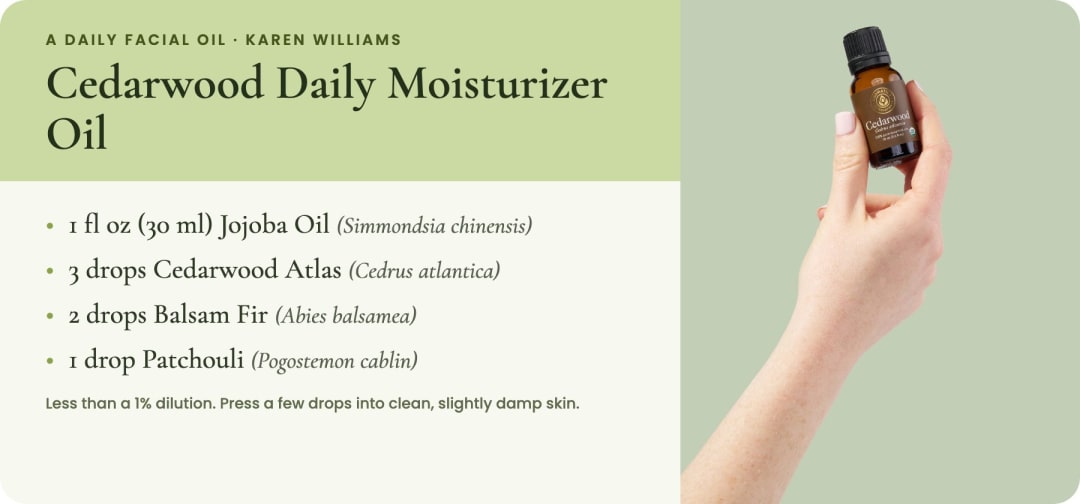
Cedarwood Daily Moisturizer Oil
A lightweight daily facial oil for dry skin, from Karen Williams. Cedarwood, balsam fir, and patchouli give it a dry, forest-like character, and jojoba keeps it wearable. This blend sits at less than a 1% dilution.
Ingredients
- 1 fl oz (30 ml) Jojoba Oil (Simmondsia chinensis)
- 3 drops Cedarwood Atlas (Cedrus atlantica)
- 2 drops Balsam Fir (Abies balsamea)
- 1 drop Patchouli (Pogostemon cablin)
Directions
- Add the jojoba to a clean 1 oz bottle.
- Add the essential oils.
- Cap and roll gently between your palms to blend.
- Press a few drops into clean skin, or massage over the face and neck.
It is best on slightly damp skin, right after cleansing. Keep it out of your eyes, and off broken or irritated skin. Safe for kids over six. If you are asthmatic, smell the cap of each oil before you blend.
Safety
Cedarwood has no known safety issues. That is rare, and it is why I use it so freely.
You may read in some books that cedarwood should be avoided during pregnancy. There is no research supporting that claim for Cedrus deodara. The uncertainty likely comes from the number of different trees sold under the same common name, which is one more reason to read the Latin name on the bottle. As with any oil, dilute it in a carrier for the skin and patch test if you are sensitive.
Cedarwood is one of the first oils we teach, because it is safe, versatile, and it works. If you want to learn how to build blends like these from the ground up, our Aromatherapy for Natural Living course uses cedarwood in everything from bath salts to bug spray.
References & research
- Hay IC, Jamieson M, Ormerod AD (1998) Randomized trial of aromatherapy. Successful treatment for alopecia areata. Archives of Dermatology. doi:10.1001/archderm.134.11.1349
- Takahashi Y, Shindo S, Kanbayashi T, Takeshima M, Imanishi A, Mishima K (2020) Examination of the influence of cedar fragrance on cognitive function and behavioral and psychological symptoms of dementia in Alzheimer type dementia. Neuropsychopharmacology Reports. doi:10.1002/npr2.12096

Lead instructor and face of Aromahead. Karen has taught tens of thousands of students to blend with confidence, from first drop to clinical practice.
This is what Natural Living begins, and certification completes.
Start with the chemistry, safe dilution, and blending in Natural Living · Natural Living. Free to begin.
A new oil, a recipe, and a lesson — every week.
Join the free weekly email and keep learning between visits. No spam, just good aromatherapy.
Free forever · unsubscribe anytime · written by the Aromahead instructor team.