Jojoba Oil Benefits & Uses: The Carrier That Closely Resembles the Skin's Own Sebum
 By Karen Williams · August 3, 2026 · 4 min read
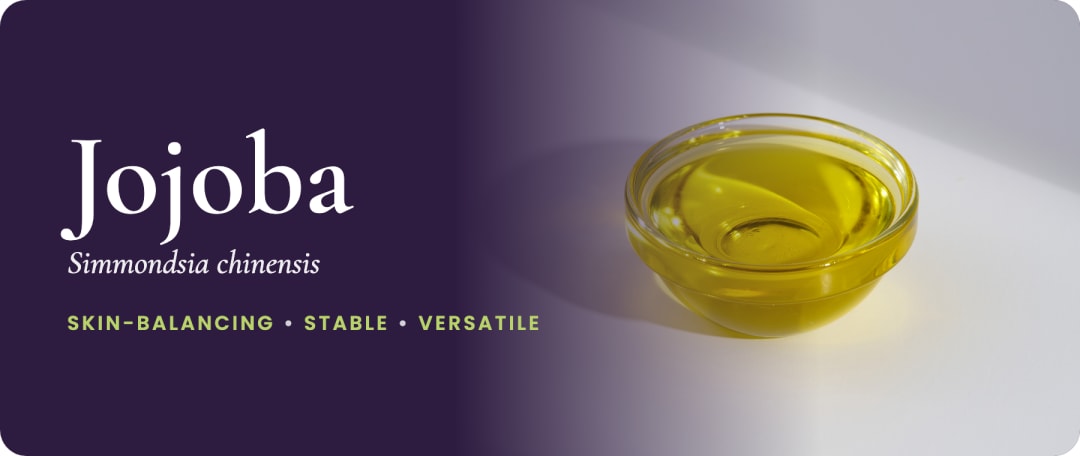
Jojoba oil is cold pressed from the seeds of Simmondsia chinensis, a desert shrub, and it is the carrier we reach for more than any other at Aromahead. It appears in over 400 of our recipes. If you keep just one carrier oil on your shelf, this is the one I would pick.
Why does jojoba come up first, with so many carriers to choose from? The answer is in your skin.
Why your skin recognizes jojoba
Jojoba closely resembles sebum, the natural coating our bodies produce to protect the skin and keep it supple.
We lose sebum as we age. Sun, wind, and cold take their share too. Jojoba can help replace what is lost, and because its structure sits so close to sebum's, the skin recognizes it and absorbs it easily.
There is more in the seed than moisture. Jojoba carries protein, minerals, and a waxy substance that mimics collagen. It is a favorite for conditioning hair, too.
What the research shows
Jojoba calms inflammation and supports faster wound healing (Pazyar et al. 2013). One study found it “accelerates wound closure of both keratinocytes and fibroblasts” (Ranzato et al. 2011). Research on plant oils and the skin barrier points the same way: topical jojoba supports repair while easing inflammation (Lin et al. 2018). The full citations are at the end of this article.
A wax that pours like an oil
You will see us write jojoba wax as often as jojoba oil, and both names suit it. It pours like an oil and it keeps like a wax: the shelf life is about twenty years. Nothing else on our carrier shelf comes close to that.
Centuries in the desert
The first written record of jojoba dates to 1701, and Native Americans were working with it long before that. They crushed the seeds to make an oil for sores, cuts, and burns, and used it to moisturize and protect skin and hair against the hot desert sun.
How I use jojoba
Almost everywhere. It is the base of our body oils, massage blends, roll-ons, salves, bath salts, and facial serums.
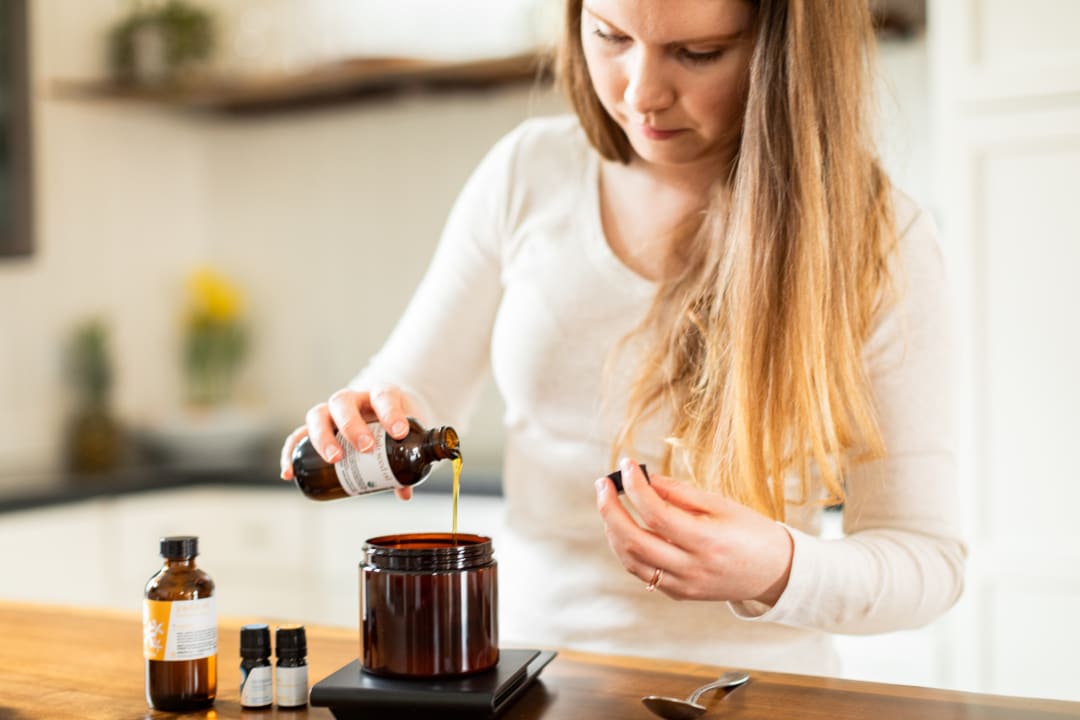
For a relaxation massage blend, I usually stick to about a 2% dilution. That is 10 to 12 drops of essential oil for every 1 oz (30 ml) of jojoba. Sore muscles after a long hike? I will go to 3%, which is 15 to 18 drops per ounce.
For a bath, combine a few drops of essential oil with a tablespoon of jojoba before adding it to the water. One note from experience: carrier oils can make the tub slippery, so step carefully.
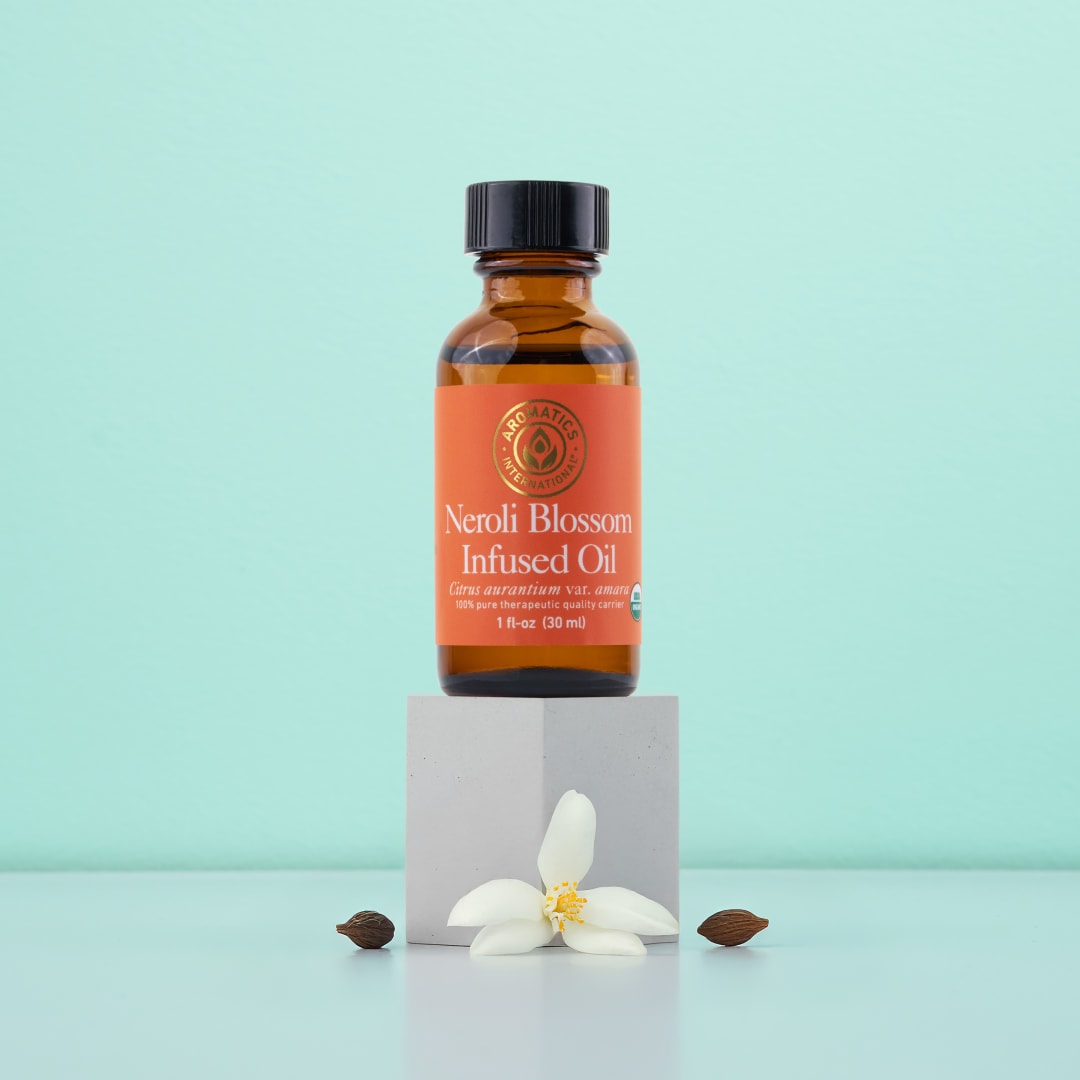
We also love infused jojobas. Neroli blossoms or vanilla steeped in jojoba give the carrier an aroma worth wearing all on its own.
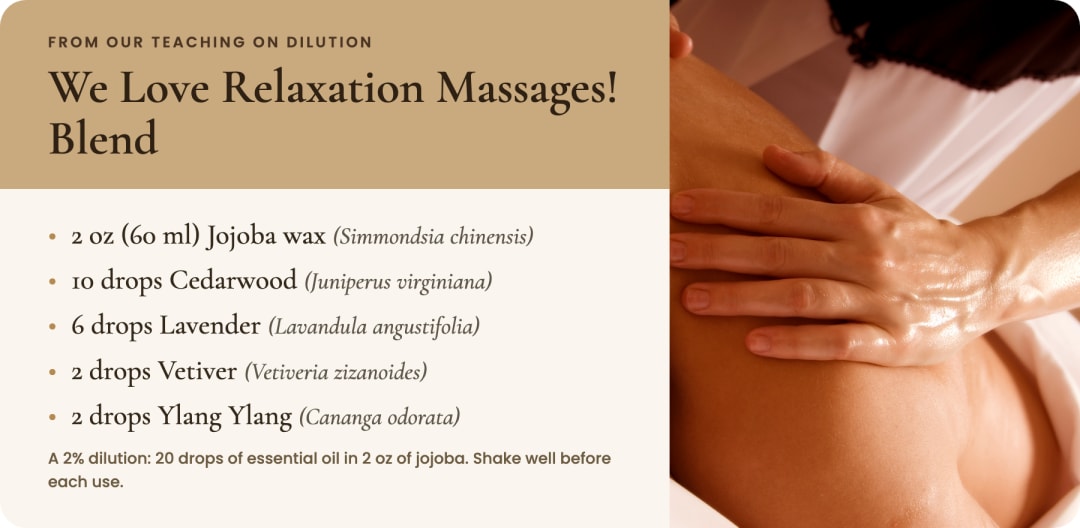
We Love Relaxation Massages! Massage Blend
Here is one of my favorite massage blends, straight from our teaching on dilution. It calms the mind and relaxes the body, and it shows jojoba doing what it does best. You will need a 2 oz (60 ml) glass bottle.
Ingredients
- 2 oz (60 ml) Jojoba wax (Simmondsia chinensis)
- 10 drops Cedarwood essential oil (Juniperus virginiana)
- 6 drops Lavender essential oil (Lavandula angustifolia)
- 2 drops Vetiver essential oil (Vetiveria zizanoides)
- 2 drops Ylang Ylang essential oil (Cananga odorata)
Directions
- Add the jojoba to the bottle.
- Drop the essential oils into the bottle.
- Shake well to combine, and again before each use.
That is a 2% dilution: 20 drops of essential oil in 2 oz (60 ml) of jojoba.
Safety
Jojoba has no known safety issues. We recommend a patch test for sensitivity, as with any carrier.
Want to work with jojoba hands on? In Body Butters & Lip Balms, you will blend it into natural body care of your own, with every ingredient explained as you go.
References & research
- Lin, T.K., Zhong, L., Santiago, J.L. (2018) Anti-Inflammatory and Skin Barrier Repair Effects of Topical Application of Some Plant Oils. International Journal of Molecular Sciences. 19, no. 1: 70.
- Pazyar, N., Yaghoobi, R., Ghassemi, M.R., Kazerouni, A., Rafeie, E., Jamshydian, N. (2013) Jojoba in dermatology: a succinct review. Giornale Italiano de Dermatologia e Venereologia. 148(6):687-91.
- Ranzato, E., Martinotti, S., Burlando, B. (2011) Wound healing properties of jojoba liquid wax: an in vitro study. Journal of Ethnopharmacology. 134(2):443-9.

Lead instructor and face of Aromahead. Karen has taught tens of thousands of students to blend with confidence, from first drop to clinical practice.
This is what Natural Living begins, and certification completes.
Start with the chemistry, safe dilution, and blending in Natural Living · Natural Living. Free to begin.
A new oil, a recipe, and a lesson — every week.
Join the free weekly email and keep learning between visits. No spam, just good aromatherapy.
Free forever · unsubscribe anytime · written by the Aromahead instructor team.